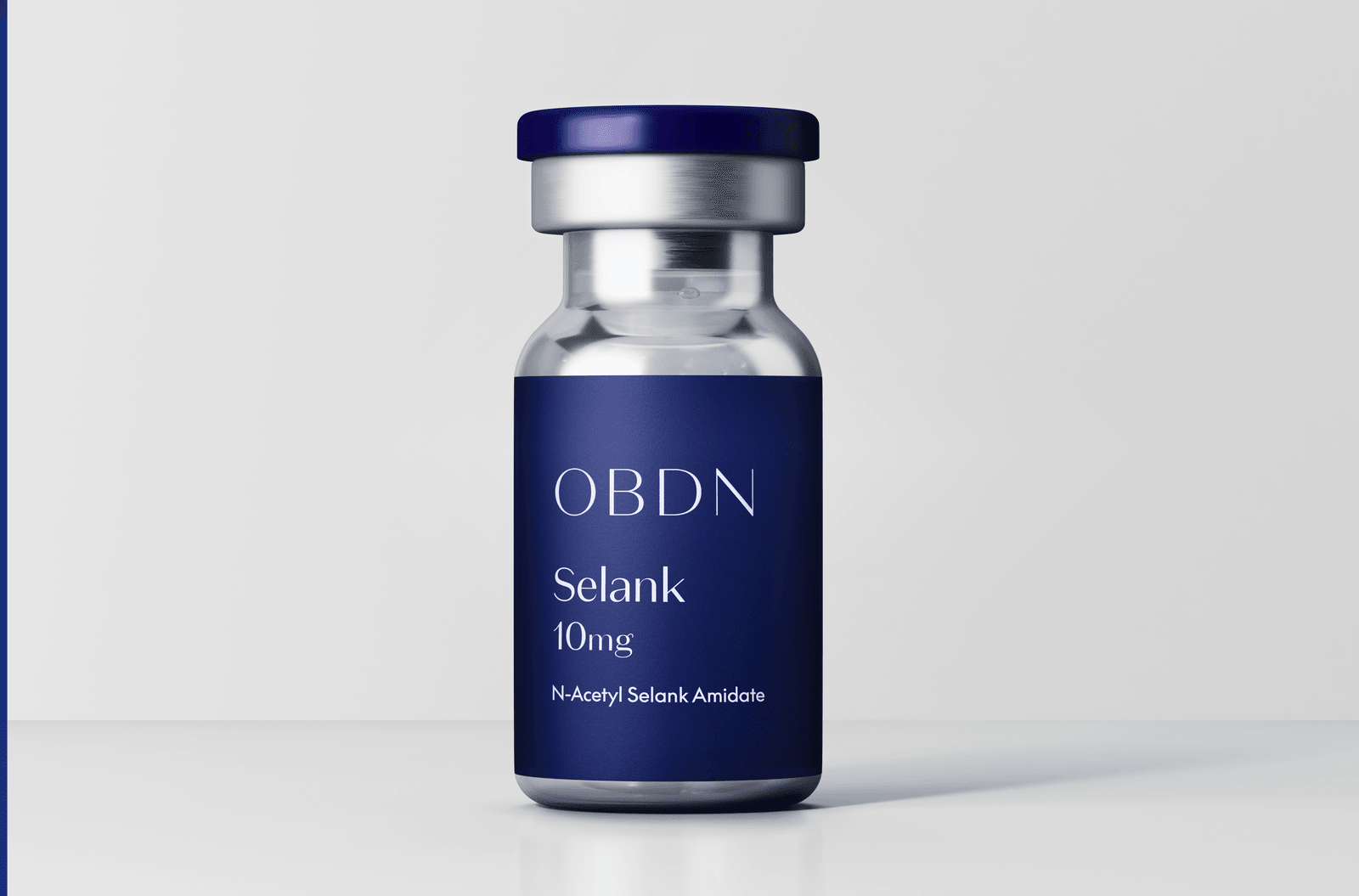
Low StockA stabilized heptapeptide derived from tuftsin (an endogenous immunomodulatory fragment) that influences anxiety and cognitive tone through gene expression rather than direct receptor binding.
It upregulates the genes encoding GABA receptor subunits, shifting receptor availability over days rather than minutes. This mechanism distinguishes it from compounds that bind receptors directly.
Also increases BDNF, linking its effects to longer-term neuroplastic adaptation.
Made in USA•Purity: 99% HPLC
Russian clinical trials in anxiety disorders; head-to-head comparison with benzodiazepines; 2024 post-COVID recovery trial
For laboratory research use only.
Selank has been studied for its effects on anxiety — reducing symptoms comparably to benzodiazepines in clinical trials, but without the sedation, cognitive fog, or dependence. Approved in Russia as an anxiolytic and nootropic since 2009, Selank has accumulated substantial clinical use data.
In head-to-head comparisons with phenazepam, patients showed equivalent anxiety reduction while maintaining cognitive clarity and experiencing no withdrawal.
What makes this unusual: Selank doesn't force GABA receptors open the way benzodiazepines do. Instead, it has been shown to upregulate the genes that build GABA receptor components — enhancing the brain's own inhibitory machinery rather than overriding it. This indirect mechanism may explain why cognitive function stays intact.
N-Acetyl Selank Amidate is a stabilized form of Selank with protective caps on both ends of the molecule — extending its half-life in experimental systems.
GABAergic Gene Expression
Transcriptomic analysis has demonstrated Selank upregulates genes involved in GABAergic neurotransmission — including receptor subunits and downstream signaling components. This molecular work provides the foundation for how an anxiolytic can work without causing sedation. BDNF and Neuroplasticity
In murine hippocampal and frontal cortex tissue, Selank administration has been associated with increased BDNF mRNA and protein levels — changes linked to synaptic plasticity and the brain's capacity to adapt.
Generalized Anxiety Disorder
In clinical studies, Selank reduced anxiety scores comparably to benzodiazepine treatment — without sedation, cognitive impairment, or withdrawal. Comparative trials against phenazepam confirmed equivalent effect with substantially better tolerability. SSRI Augmentation
About 40% of patients starting antidepressants experience delayed onset or residual symptoms. When Selank was added during early treatment, 70% showed meaningful anxiety reduction by day 14 — improvements that persisted two weeks after stopping Selank. Post-Viral Recovery
A 2024 randomized trial in 64 post-COVID patients found that adding intranasal Selank to standard care improved mental work capacity, reduced anxiety and depressive symptoms, and resolved fatigue better than standard care alone.
Clinical evidence comes primarily from Russian institutions with limited Western replication. Most studies run 2–4 weeks. Long-term safety has not been established.
The N-acetyl amidate modification enhances stability but creates a compound not identical to the Selank in clinical trials — pharmacokinetic equivalence should not be assumed.
For laboratory research use only.
| Amino Acid Sequence | Ac-Thr-Lys-Pro-Arg-Pro-Gly-Pro-NH2 |
|---|---|
| Single-Letter Code | TKPRPGP |
| Molecular Formula | C35H59N11O10 |
| Molecular Weight | 793.92 g/mol |
| Amino Acid Count | 7 |
| CAS Number | 2212313-10-6 |
| Origin | N-acetylated, C-terminal amidated analog of Selank, a synthetic peptide derived from the endogenous tetrapeptide tuftsin (Thr-Lys-Pro-Arg) with a C-terminal glyproline extension |
| Synonyms | N-Acetyl Selank, Selanc, TP-7 |
This product ships as lyophilized (freeze-dried) powder. After reconstitution, the solution requires different storage conditions than the powder.
Do not freeze. Use within 30 days of mixing.