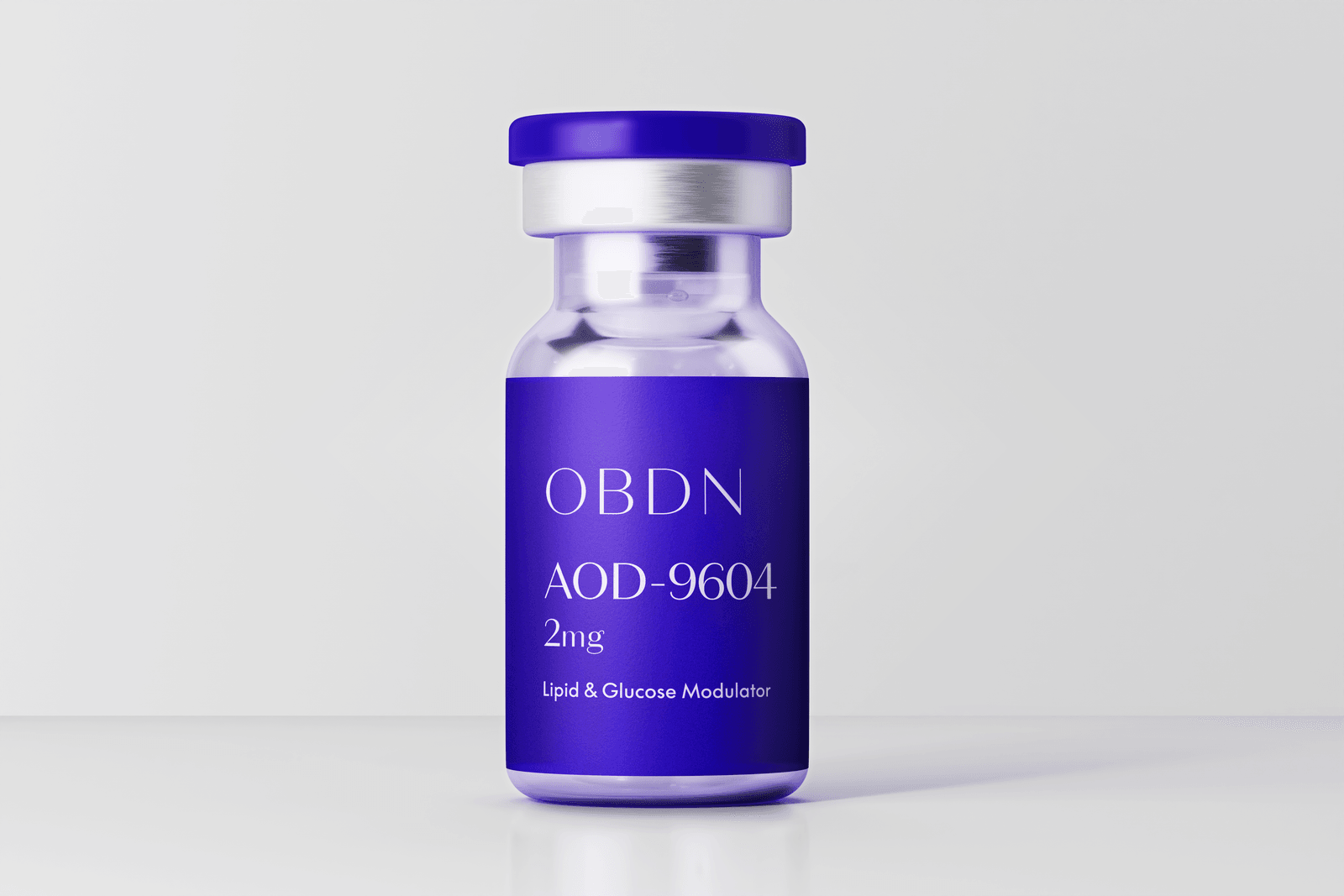
Low StockA fragment of growth hormone (amino acids 176–191) that influences fat metabolism without the complications of full-length hGH.
It acts on adipocyte receptors to shift the balance toward lipid mobilization — without elevating IGF-1, affecting insulin sensitivity, or activating growth signaling.
This selectivity is why it was developed: to isolate the lipolytic activity of GH from its proliferative and diabetogenic effects.
Made in USA•Purity: 99% HPLC
Preclinical lipolysis data confirmed in animal models; early human safety established but Phase IIb obesity efficacy was not met
For laboratory research use only.
AOD-9604 is the lipolytic fragment of growth hormone — the segment associated with signaling fat cells to mobilize stored energy, isolated from the growth-promoting effects that make full-length hGH problematic for metabolic research. It consists of amino acids 176–191 from human growth hormone, modified to resist breakdown.
The key distinction: AOD-9604 does not raise IGF-1, does not affect insulin sensitivity, and does not promote tissue growth. In preclinical studies, it stimulates lipolysis (fat breakdown) while inhibiting lipogenesis (fat storage) — without the metabolic side effects of full-length growth hormone. However, clinical efficacy for weight loss has been modest, positioning AOD-9604 as safety-strong but efficacy-limited.
In murine models spanning 12–24 weeks, AOD-9604 administration produced sustained fat mass reductions without changes in lean body mass, bone metabolism markers, or endocrine axis engagement. Serum IGF-1 concentrations remained unchanged throughout treatment periods. Effects were preferential in obese fat depots versus lean adipose tissue.
A pooled analysis of six randomized, double-blind, placebo-controlled Phase 1/2 trials (>900 participants) demonstrated that AOD-9604 is exceptionally well tolerated:
This data supports the idea that AOD-9604 behaves like placebo with respect to major endocrine and glycemic safety signals.
A 24-week Phase 2b trial (~534 obese adults) evaluated multiple doses of oral AOD-9604. The fragment showed placebo-comparable safety profiles. Modest weight loss differences (~2% net difference) were observed compared to placebo, though results did not meet regulatory efficacy thresholds for obesity indication. Development as a stand-alone obesity therapy was discontinued.
Unlike most peptides that degrade in the gut, AOD-9604 demonstrates detectable bioavailability following oral administration — an unusual property that enabled oral dosing in clinical trials.
Separate research has examined AOD-9604's effects on chondrocyte function and cartilage matrix dynamics in osteoarthritis models. These effects appear mechanistically independent from its adipocyte activity, suggesting biological properties beyond fat metabolism. Mechanisms remain poorly defined.
In 2019, AOD-9604 received Generally Recognized As Safe (GRAS) status from the FDA for use as a food ingredient — an unusual classification for a bioactive peptide. This reflects review of available toxicology data but does not constitute approval for therapeutic use.
Phase 2b trial results did not meet efficacy thresholds for obesity indication approval. The ~2% net weight loss difference is small compared to modern incretin-based therapies achieving 15–25%. While preclinical lipolytic effects are well-characterized through β-3 receptor pathways, translation to clinical weight loss endpoints has been modest. Most clinical data comes from oral administration studies; injectable pharmacokinetics may differ. AOD-9604 is best understood as a safety-strong but efficacy-modest fragment — potentially useful as a fine-tuning adjunct in optimized protocols rather than a primary intervention.
For laboratory research use only.
| Amino Acid Sequence | Leu-Arg-Ile-Val-Gln-Cys-Arg-Ser-Val-Glu-Gly-Ser-Cys-Gly-Phe |
|---|---|
| Single-Letter Code | LRIVQCRSVEGSCGF |
| Molecular Formula | C78H123N21O23S2 |
| Molecular Weight | 1815.08 g/mol |
| Amino Acid Count | 15 |
| CAS Number | 221231-10-3 |
| PubChem CID | 71300550 |
| Origin | Synthetic peptide corresponding to the C-terminal fragment (amino acids 176-191) of human growth hormone, with a tyrosine substitution to stabilize the lipolytic domain |
| Synonyms | AOD9604, hGH Fragment 176-191, Anti-Obesity Drug 9604, Tyr-hGH177-191 |
This product ships as lyophilized (freeze-dried) powder. After reconstitution, the solution requires different storage conditions than the powder.
Do not freeze. Use within 30 days of mixing.